

School of Medicine
Depts of Anatomy & Neurobiology, Developmental & Cell Biology, and Center for Complex Biological Systems
Systems Biology of Stem Cells and Human Developmental Disorders
BA: Reed College, Portland, OR (Phi Beta Kappa)
PhD: University of California, San Francisco, School of Medicine (Molecular Neurobiology)
Postdoctoral Research: Columbia University (New York, NY); Tufts University School of Medicine (Boston, MA
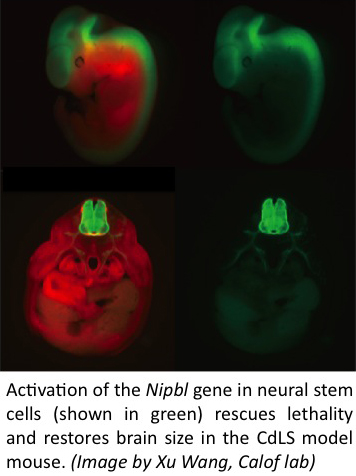
Systems Biology of Stem Cells and Human Developmental Disorders – Our overall goal is to understand how changes in cell lineage progression parameters and expression of diverse genes act in concert to direct normal development and, when development goes awry, to cause syndromic and non-syndromic birth defects. In much of this work, we use mouse and zebrafish models of Cornelia de Lange Syndrome, a multi-system birth defects disorder caused by Nipbl haploinsufficiency, as systems with which to understand these questions. Our studies of CdLS model systems have led to new insights into determinants of risk for development of congenital heart disease and patterning defects during development. Our current work on these models uses bulk and single-cell transcriptomics and multiomics to understand how gene expression changes alter allocation of stem cells to different lineages during gastrulation, as well as to understand the non-linear relationship between gene expression changes and the variable penetrance and expressivity of CdLS phenotypes.
Feedback Signaling and Modeling of Tissue Growth and Development – We also collaborate with other groups employ computational modeling in our research, which has helped to shape hypotheses to explore parameters directing cell lineage progression and tissue morphogenesis in different tissue types; these include neural epithelia, skin, and breast tissue. We have published numerous papers using modeling approaches to explore the role of feedback in regulation of proliferative control and spatial patterning in epithelia, and have a particular interest in the role of TGF-beta superfamily signaling molecules in regulating feedback control of cell lineage progression during development, regeneration, and the onset and progression of neoplasia and cancer.
Representative Publications
- Chea S, Santos R, Lopez-Burks ME, Lander AD, Calof AL*. Interaction between long-range chromatin regulators Nipbl & Isl1 synergistically drives heart defects in mice.bioRxiv 2025 May 19:2025.05.15.654123. doi: 10.1101/2025.05.15.654123 PMCID: PMC12139810 PMID: 40475661
- Chea S, Kreger J, Lopez-Burks ME,Maclean AL, Lander AD, Calof AL*. Gastrulation-stage gene expression in Nipbl+/- embryos foreshadows the development of syndromic birth defects. Science Advances, 2024. PMID: 38507484, PMCID: PMC10954218
- Kean CM, Tracy CJ, Mitra A, Rahat B, Van Winkle MT, Gebert CM, Noeker J, Calof AL*, Lander AD, Kasis JA, and Pfeifer. (2022). Decreasing Wapl dosage partially corrects embryonic growth and brain transcriptome phenotypes in Nipbl+/- embryos. Science Advances 2022 Nov; 8(48): eadd4136. doi: 10.1126/sciadv.add4136. PMCID: PMC9710879
- Calof AL, Santos R, Groves L, Oliver C, and Lander AD. “Cornelia de Lange Syndrome: Insights into Neural Development from Clinical Studies and Animal Models.” (2020) In: Neurodevelopmental Disorders (J. Rubenstein, P. Rakic, B. Chen, K.Y. Kwan, Editors; A. Winshaw-Boris, Section Editor), Academic Press.
- Santos R, Kawauchi S, Jacobs RE, Lopez-Burks ME, Choi H, Wikenheiser J, Hallgrimsson B, Jamniczky HA, Fraser SE, Lander AD, Calof AL*. Conditional Creation and Rescue of Nipbl-Deficiency in Mice Reveals Multiple Determinants of Risk for Congenital Heart Defects. PLoS Biol. 2016 Sep 8;14(9):e2000197. doi: 10.1371/journal.pbio.2000197. PubMed PMID: 27606604; PubMed Central PMCID: PMC5016002. (*corresponding author)
- Kawauchi, S., R. Santos, A. Muto, M.E. Lopez-Burks, T.F. Schilling, A.D. Lander and L. Calof (2016) Using Mouse and Zebrafish Models to Understand the Etiology of Developmental Defects in Cornelia de Lange Syndrome. Am J Med Genet C Semin Med Genet. 172(2):138-45. doi: 10.1002/ajmg.c.31484. PMID: 27120001.
- Kunche, S., H. Yan, A.L. Calof*, J.S. Lowengrub and A.D. Lander (2016) Feedback, lineages and self-organizing morphogenesis. PLoS Computational Biol, 12, e1004814. doi:10.1371/journal.pcbi.1004814. Cited in PLoS Collections, Editor’s Picks in Stem Cell Research (http://collections.plos.org/stem-cell-research).
- Lander AD, Kimble J, Clevers H, Fuchs E, Montarras D, Buckingham M, Calof AL, Trumpp A, and Oskarsson T (2012) What does the concept of the stem cell niche really mean today? BMC Biology, 10, 19: pp 1-15; doi: 10.1186/1741-7007-10-19.
- Santos R, Wu H-H, Hamilton J, Pinter R, Hindges R & Calof, AL (2012) Restoration of retinal development in Vsx2 deficient mice by reduction of Gdf11 activity. Adv. Exp. Med. Biol. 723: 671-677. PMID 22183392
- Gokoffski K, Wu H-H, Beites CL, Kim J, Kim E, Matzuk MM, Johnson JE, Lander AD & Calof AL (2011) Activin and GDF11 collaborate in feedback control of neuroepithelial stem cell proliferation and fate. Development, 138: pp. 4131-4142.
- Gokoffski, K.K., Kawauchi, S., H.-H. Wu, R. Santos, P.W.L. Hollenbeck, A.D. Lander and L. Calof (2010) “Feedback regulation of neurogenesis in the mammalian olfactory epithelium: New insights from genetics and systems biology.” In: Neurobiology of Olfaction, (A. Menini, Ed.) CRC Press, pp. 241-265. PMID:21882434.
- Lander, A.D., Gokoffski, K.K., Wan, F., Nie, Q., and Calof, A.L. (2009) Cell Lineages and the logic of proliferative control. PLoS Biology 7(1): e1000015. doi:10.1371/journal.pbio.1000015. ** Reviewed in G.T. Reeves & S.E. Fraser (2009) “Biological Systems from an Engineer’s Point of View”, PLoS Biology Primer, PLoS Biol 7(1): e1000021.
- Kawauchi, S., Kim, J., Santos, R., Wu, H. H., Lander, A. D. and Calof, A. L. (2009). Foxg1 promotes olfactory neurogenesis by antagonizing Gdf11. Development 136, 1453-64.
- Beites, CL, Hollenbeck, PLW, Kim, J, Lovell-Badge, R, Lander, AD, and Calof, AL (2009) Follistatin modulates a BMP autoregulatory loop to control size and patterning of sensory domains in the developing tongue. Development, 136: 2187-2197.
- Kawauchi, S, Calof, AL**, Santos, R., Lopez-Burks, ME, Young, CM, Hoang, MP, Chua, A., Lao, T., Lechner, MS, Daniel, JA, Nussenzweig, A., Kitzes, L., Yokomori, K., Hallgrimsson, B. and Lander, A.D. (2009) Multiple organ system defects and transcriptional dysregulation in a mouse model of Cornelia de Lange Syndrome. PLoS Genetics 5(9): e1000650. Doi:10.1371/journal.pgen.1000650.
- Kawauchi S, Shou J, Santos R, Hebert JM, McConnell SK, Mason I, Calof AL. Fgf8 expression defines a morphogenetic center required for olfactory neurogenesis and nasal cavity development in the mouse 2005 Development 132 (23): 5211-5223. doi.org/10.1242/dev.02143** **Previewed in Development (2005) 132 (23): e2303 “Fgf8 noses into olfactory development”
- Kim J, Wu HH, Lander AD, Lyons KM, Matzuk MM, Calof AL. GDF11 controls the timing of progenitor cell competence in developing retina. Science. 2005 Jun 24;308(5730):1927-30. PMID: 15976303 ** Editor’s Choice, STKE Science, 2005, “Calling New Neurons” DOI: 10.1126/stke.2902005tw236
- Wu HH, Ivkovic S, Murray RC, Jaramillo S, Lyons KM, Johnson JE, Calof AL. Autoregulation of neurogenesis by GDF11. Neuron. 2003 Jan 23;37(2):197-207. PMID: 12546816 ** Previewed in Gamer et al., Developmental Cell 2003 “Return of the Chalones” ( http://dx.doi.org/10.1016/S1534-5807(03)00027-3)